

For three days on Tunisia’s coast, women from across the Mediterranean came together to talk about fishing, but also about much more than fishing. They shared experiences, compared the challenges facing their communities and, above all, looked for practical ways to build a more inclusive and resilient future for the people who live by the sea.
Women Together in Fisheries 2026, organised by WWF Mediterranean and WWF North Africa from 5 to 7 October, brought together more than 90 women from ten Mediterranean countries: fishers, seafood processors, cooperative members, community leaders, researchers and practitioners. The theme was Women’s voices, women’s knowledge, our future, a phrase that captured the spirit of a meeting built around listening and exchange rather than formal presentations.

The women came from different countries and different parts of the fisheries sector, but they soon discovered how much their experiences had in common. Through a series of interactive World Café discussions, they moved between small groups, exchanging stories, identifying shared problems and discussing solutions already being tested in their communities. The format created space for experiences that are rarely reflected in official accounts of fisheries.
“The diversity in the room was incredibly powerful,” said Luca Eufemia, fisheries manager at WWF Mediterranean. ” Women came together from diverse backgrounds, united by their love of the sea and a shared commitment to learning, connection and a stronger future for women in fisheries. The retreat created a space to share knowledge, experiences and challenges, while recognising the vital contribution women make across fisheries and coastal communities. It was a powerful reminder that when women come together, their collective knowledge and voice can help shape the future of the sector.”
One of the central questions was also one of visibility. Women are present throughout the Mediterranean fishing economy, from preserving traditional knowledge to processing and marketing fish, supporting family livelihoods and strengthening local economies. Yet their contribution often remains largely invisible in official statistics, decision-making and the public image of the fishing sector.

The second day took the discussion out of the meeting room and into the coastal community of Ghar El Melh, in the governorate of Bizerte. There, participants met women involved in fisheries-related activities and local cooperatives, hearing directly about the opportunities and difficulties they face in their daily work.
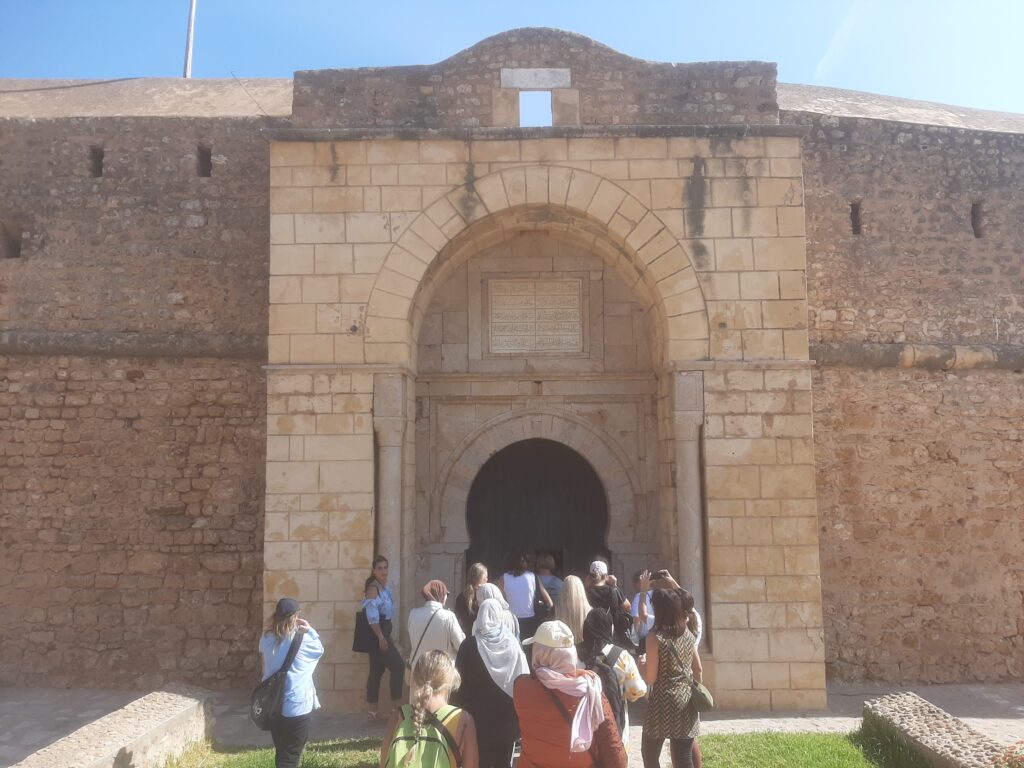
The visit also showed how much innovation can come from local knowledge. Chourouk Alya, a Tunisian fisherwoman, returned from the field visit with an idea she would like to apply to her own work.
“I have really benefited from the exchanges over these days, particularly from an innovation perspective,” she says. In Ghar El Melh, participants were shown drina traps made from biodegradable materials, which are less harmful to the environment in the long term. The traps are used locally to catch blue crab, a species that has become increasingly common in Tunisian waters as a result of climate change and has now found its way into local cuisine.

“The same approach can also be adapted for other species,” Alya observed. “I would now like to apply this methodology in my own work.”
It was a small example, but it illustrated one of the ideas running through the three days: solutions do not necessarily have to come from outside a community. They can emerge from the experience of people already working at sea and along the coast, and then travel from one Mediterranean community to another.
The challenges, meanwhile, are familiar across much of the region. Women spoke about the need for better access to information, training, finance and markets, as well as greater opportunities to participate in the decisions that govern fisheries. They also stressed the importance of networks that allow women to exchange knowledge, develop leadership skills and make their work more visible.
Behind these practical obstacles lie social norms and stereotypes that can still restrict women’s opportunities in some coastal communities. At the same time, many of these women possess a form of knowledge that is particularly valuable at a time when the Mediterranean is changing rapidly: an understanding of marine resources, fishing practices and local heritage accumulated over generations.

The challenges women face are well summed up by Raquel Sanchez Garcia, a fisher and esthetician from Aguilar, Murcia, in Spain. “In the fishing sector in the port where I live, women have always played an important role, but mainly in terms of management and administration, taking care of the family business. In other words, more behind the scenes, rather than out at sea, actually going fishing. They have always had a very important role, and that’s what I used to do, as did many of my fellow women boat owners. But there had never been a woman who went out fishing every day. So people were like, ‘Where do you think you’re going?’ My father was the first person to tell me, ‘You’re not going to be able to do it.’ My colleagues would say, ‘You’re crazy. I mean, this isn’t painting nails.’ And, well, I’m a fighter, and I also really loved the sea, so I believed in myself, I got into it, and I’m very happy I did.”
Climate change has made this knowledge even more important. Changes in fish populations are already altering the work of fishing communities, while new species such as the blue crab are becoming part of local ecosystems and economies. The experience shared in Ghar El Melh showed how adaptation can involve both traditional knowledge and new approaches, from different fishing techniques to biodegradable equipment.

Sarah Souisi, a fisherwoman from Tunisia’s Kerkennah Islands, runs her own fishing boat. “I am the captain of my boat. I love my job, and I love the sea. I will continue doing it, and I don’t care what others think about women fishing,” she says. At the port, she chats with a fisherman and even briefly steps aboard his boat — a small gesture that says something about how far the boundaries of a traditionally male profession can be pushed.

For Maha Ben Mahmoud, a fisherwoman from Ghannouch in Tunisia, being at sea is both a passion and a family affair.
“For me, the sea is life. I love the sea. No matter what problems or things I have going on in my head, I go there, especially at night. I go out at night, or very early in the morning, and I sit in front of it and forget everything. How did I come to love it? I loved my father very much. I was very attached to my father, may he rest in peace. Very, very much. My father was a fisherman. He used to fish for octopus and cuttlefish, especially octopus.
“I used to go out with him on the boat and we would fish for octopus. – she recalls – He would spend the night setting the traps. He would take them to another area, called Al-Hicha, and put them there during the day. And every night you would hear me saying, ‘Please, Dad, please, Dad, take me with you, take me with you.’ I always felt that because I had three brothers before me, I was almost a boy myself. I wasn’t really raised as a girl. I felt very close to my brothers. I would go out with my older brothers and my father. We would go to Al-Hicha, and he would collect the traps. The most beautiful feeling was when he brought back the catch and the octopus came out. Watching how he caught the octopus… Then he would come back to work in Ghannouch and fish there. At the same time, he had another job. He was a craftsman. He would sell sheep skins to tourists. So I learned from my father to love the sea and to love handicrafts.”
Maha has also made environmental protection part of her work. “I do handicrafts too. I recycle marine waste and fishing nets, shells and things like that. When I first started working with bottles, I always wanted my surroundings to be clean. I have always wanted the sea to be clean. I feel that the sea is my world. I don’t like seeing rubbish lying around. Whenever I go out, I don’t like to find anything thrown away or scattered around.”
It was no coincidence, then, that the final day shifted the focus from fishing to another major Mediterranean challenge: marine litter. Participants explored circular-economy initiatives and examples of how waste materials can be transformed into products, skills and new sources of income. Once again, the environmental problem was considered together with the economic future of coastal communities.
What emerged from the three days in Tunisia was therefore less a list of recommendations than a network of experiences. Women who had never met before discovered common problems, but also discovered that solutions developed in one place might offer ideas for another. But the three days in Tunis were not only about serious issues. There was also dancing, with women moving to the rhythm of popular songs from their different countries — even on the bus to Ghar El Melh.
In the end, the meeting put a different face on Mediterranean fisheries: not only the boats, the fishermen and the catch, but the women whose work keeps much of the coastal economy moving and whose knowledge can help communities adapt to a changing sea. As the gathering ended, one idea remained at its centre: across different shores, languages and traditions, Mediterranean women share a determination to strengthen their role in fisheries, support their communities and have a say in the future of the sea they share.
